

Debt Collection for Small Businesses: Minimum Amount & Process Explained

Debt Collection for Small Businesses: Minimum Amount & Process Explained
Key Takeaways
- There is no legal minimum debt amount for collections, but practical business considerations typically establish informal thresholds between $100 and $500 for small business accounts.
- Small businesses benefit from contingency-based collection models, in which they pay only 10–25% of the recovered amounts after successful collection.
- The collection process begins with internal efforts, transitions to professional agency involvement after 60–90 days, and may escalate to legal action when account values justify the expense.
- Southwest Recovery Services delivers specialized small-business collection support with flexible contingency pricing, omnichannel communication strategies, and industry-specific expertise to maximize recovery while maintaining professional business relationships.
Understanding Debt Collection Challenges for Small Businesses
Small business owners face unique cash flow challenges when customers delay or avoid payment. Unlike large corporations with dedicated credit departments and substantial cash reserves, small businesses operate on tighter margins where even modest unpaid invoices can disrupt operations, delay vendor payments, or prevent strategic investments.
Many small business owners hesitate to pursue collections, fearing they’ll damage customer relationships or invest resources in recovery efforts that ultimately cost more than the debt itself. This hesitation allows receivables to age, reducing the likelihood of recovery while cash flow problems compound. Understanding when and how to engage professional collection assistance helps small businesses recover what they’re owed without sacrificing customer relationships or operational focus.
A dedicated collection agency for small business accounts removes that risk by working on contingency, with no upfront cost.
|
Southwest Recovery Services: Get Your Money Back 22+ Years Experience | Texas-Based | Contingency Only – You Pay When We Collect
Built for Commercial Collections:
The Southwest Recovery Difference: ✓ Contingency only – no upfront costs ✓ Veteran collectors with respectful omnichannel outreach ✓ Priority sectors: trucking, logistics, contractors, oil & gas ✓ Clear reporting on account status and outcomes Trust & Results You Need: Nationally recognized ethical collections agency with 12 offices across six states. Compliance-first approach with no threats or guarantees. |

Is There a Minimum Amount for Debt Collection?

From a strictly legal perspective, businesses can send debts of any size to professional collection agencies. An unpaid invoice of $25 carries the same legal standing as a $25,000 commercial debt. Both can be pursued through collection efforts, reported to credit bureaus, and potentially result in legal action if debtors remain unresponsive.
While the law permits collecting debts of any amount, economic reality creates practical minimums that vary significantly across agencies and industries.
For small-business debts, agencies typically consider accounts viable when they exceed $100 to $500, though this threshold varies depending on multiple factors, including debt age, documentation quality, and debtor payment history.
The contingency fee structure standard in commercial collections directly influences these thresholds. When agencies charge 10–25% of recovered amounts, a $75 debt yields only $56–$68 after fees. Pursuing such small amounts only makes economic sense when volume justifies the effort.
Cost-Effectiveness Analysis for Small Business Collections

Before sending any accounts to collections, small businesses should calculate their effective recovery after all costs. Professional collection agencies working on a contingency basis typically charge 10–25% of the successfully recovered amounts for commercial debts, with rates varying based on account age and complexity.
For a $300 invoice at a 20% contingency rate, successful collection means you receive $240. Factor in the administrative time spent gathering documentation, communicating with the agency, and processing the eventual payment, and your net recovery may be closer to $220. This calculation helps determine your minimum threshold for pursuing collection.
Individual small invoices may seem inconsequential, but their aggregate effect can be substantial. Small businesses with dozens of unpaid invoices ranging from $75 to $300 may find they have $5,000 to $15,000 in trapped working capital. This collective amount justifies professional collection efforts even when individual account values seem marginal.
Professional agencies often accept bulk placements where multiple small accounts are referred simultaneously. This volume approach makes pursuing smaller individual debts economically viable.
The Small Business Debt Collection Process
Stage 1: Internal Collection Efforts (0–60 Days Past Due)
The collection process begins immediately when invoices become overdue. During the first 30 to 60 days past due, internal collection efforts typically prove most effective and cost-efficient. Your initial approach should include sending polite payment reminders via email or postal mail within 7 days of the due date, making direct phone calls to accounting contacts at 15 and 30 days past due, and sending a formal final notice at 45 to 60 days past due that clearly outlines next steps.
During this phase, maintain a professional, solution-oriented tone. Many payment delays result from simple administrative oversights, billing disputes, or temporary cash-flow challenges rather than from intentional avoidance. Document every communication attempt, including dates, contact methods, responses received, and commitments made.
Stage 2: Professional Agency Engagement (60–120 Days Past Due)
When internal efforts produce no concrete payment commitments, and accounts reach 60 to 90 days past due, engaging a professional collection agency becomes appropriate.
At this stage, the agency initiates contact through multiple channels, including formal debt validation letters that comply with federal requirements, phone outreach to decision-makers, email campaigns with payment portal links for convenient resolution, and text message reminders when appropriate.
Professional collectors bring specialized expertise in debtor psychology, negotiation tactics, and payment arrangement structures. Agencies like Southwest Recovery Services (SWRS) employ respectful, firm communication strategies that apply appropriate pressure without resorting to aggressive tactics that damage your brand reputation.
Stage 3: Negotiation & Payment Arrangements
Most small business debts are resolved through negotiation rather than litigation. Professional collectors work to find solutions that work for both parties.
This includes structured payment plans that fit the debtor’s cash flow, partial settlements for immediate lump-sum payments when debtors face genuine financial distress, and dispute-resolution conversations that establish the undisputed balance when billing disagreements arise.
This negotiation phase requires skill and experience. Collectors must balance firmness with diplomacy, maintaining enough pressure to motivate payment while preserving the professional relationship your business may need in the future.
Stage 4: Legal Escalation (When Necessary)
If negotiation fails and debtors refuse to engage in good-faith discussions or honor payment commitments, legal action may become necessary. For small-business debts, this typically involves filing claims in small claims court for accounts below your state’s jurisdictional limit, or pursuing civil litigation through standard court procedures for larger commercial debts.
Legal action involves additional costs beyond standard collection fees. These expenses mean litigation only makes economic sense for accounts large enough to justify the investment, typically those exceeding $1,000 to $2,000.
Strategies for Small Businesses to Maximize Collections

Establish Clear Credit Policies
Prevention proves more effective than collection. Small businesses should establish clear credit policies that include conducting basic credit checks on new commercial customers requesting payment terms, setting appropriate credit limits based on customer financial stability, and clearly communicating payment terms, late fees, and collection policies in contracts and invoices.
Document Everything Thoroughly
Comprehensive documentation improves collection success rates and legal outcomes if disputes arise. Maintain organized records of any previous partial payments or payment promises.
When referring accounts to collection agencies, provide complete documentation upfront. Agencies equipped with thorough background information can engage more effectively with debtors, address disputes confidently, and accelerate resolution timelines.
Consider Bulk Placement Strategies
Small businesses with multiple outstanding accounts should consider bulk placement approaches, in which numerous accounts are referred to a collection agency simultaneously. This strategy has several advantages, including improved negotiating power, streamlined administrative processes, and economic viability.
Why Southwest Recovery Services Excels at Small Business Collections
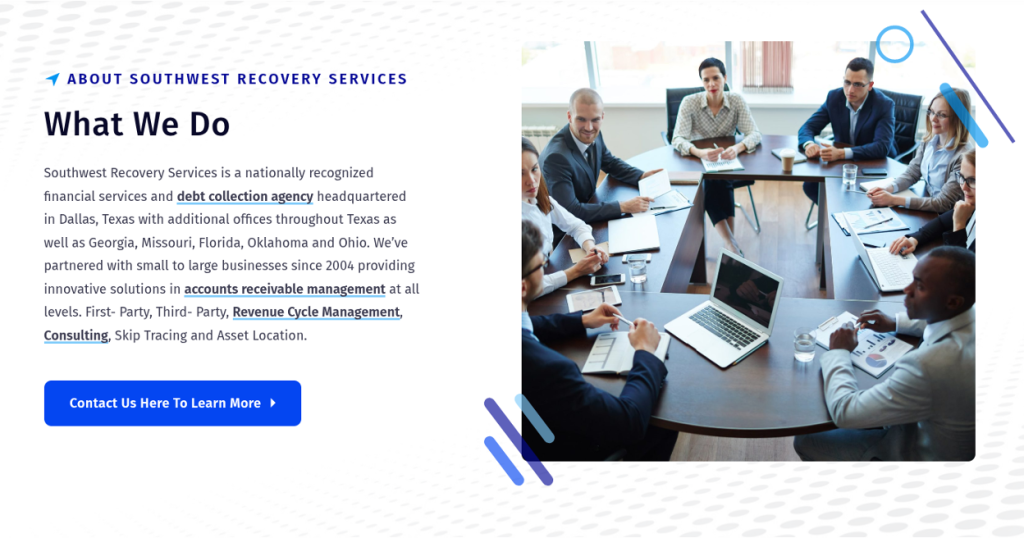
Small businesses need collection partners who understand both effective recovery strategies and the critical importance of preserving customer relationships that may become profitable again in the future. Southwest Recovery Services (SWRS) delivers this balance through 22+ years of specialized commercial collection experience.
Our contingency-only pricing model eliminates all upfront financial risk for small business clients. You invest nothing until we successfully recover your funds, and our fees are paid only from the collected amounts.
Our team recognizes that today’s difficult account may be tomorrow’s valuable customer, so we use firm yet respectful communication strategies to motivate payment while preserving professional relationships whenever possible.
Our AI-guided tracking systems monitor every account across all communication channels, including phone, email, text messaging, and traditional mail. This omnichannel approach ensures we reach debtors through their preferred communication methods while maintaining comprehensive documentation of every interaction.
We specialize in commercial collections for businesses across the revenue spectrum, with particular expertise in industries where relationship preservation and operational knowledge matter most. Our team understands your industry’s payment cycles, seasonal factors, and business pressures.
With 12 offices across six states, we combine nationwide collection reach with personalized attention and local market knowledge. Our compliance-first approach strictly adheres to all federal and state regulations, protecting your business from legal exposure while maintaining ethical collection standards.
Related: small business collection agency – dedicated services for small and mid-sized businesses.
Frequently Asked Questions (FAQs)
What is the typical minimum debt amount that collection agencies will accept?
Most collection agencies establish informal minimums between $100 and $500 for individual accounts. However, these vary significantly by debt type, age, and whether accounts are placed individually or as part of bulk portfolios. Agencies working with small businesses often accept lower minimums for bulk placements where multiple accounts are referred simultaneously.
How long should small businesses wait before sending accounts to collections?
Most small business experts recommend engaging professional collection agencies when accounts reach 60 to 90 days past due after internal collection efforts have been exhausted. Waiting significantly longer reduces the recovery probability, as debtor circumstances often deteriorate over time and accounts become increasingly difficult to collect.
Will using a collection agency damage relationships with my customers?
Professional collection agencies that prioritize relationship preservation typically maintain the possibility of future business by employing respectful, diplomatic communication strategies.
The agency serves as a neutral buffer that allows you to preserve your positive business relationship while still pursuing what you’re owed.
What alternatives exist between internal collection and full agency engagement?
Several intermediate options can bridge the gap between internal collection efforts and full agency engagement. Pre-collection services send formal notices on agency letterhead without initiating complete collection procedures, often motivating payment at significantly lower cost. Providing structured payment plans directly to debtors allows them to resolve balances over time without collection escalation.
How does Southwest Recovery Services help small businesses with debt collection?
Southwest Recovery Services provides comprehensive commercial debt collection services specifically designed for small to mid-sized businesses operating in the $10M to $100M revenue range.
Our contingency-only model eliminates upfront costs and financial risk, while our specialized B2B focus ensures we understand your industry’s unique challenges and relationship considerations. We accept accounts across the value spectrum and offer flexible bulk placement options that make pursuing smaller debts economically viable for small businesses.
*Note: Recovery rates mentioned are for general reference only and not guaranteed. Actual results vary by account and industry. Contact Southwest Recovery Services for a customized quote.



Maximize Your Cash Flow
We make it fast and easy to refer past due and delinquent accounts to our professional recovery agents. You decide the range on what you will accept on each case, and you ONLY pay a percentage of what we actually collect to resolve the case. Ready to get started, or want to learn more? Fill out this form and a dedicate account manager will call you to get started.